
Western Philosophy
- Expertise
- Western Philosophy
Western Philosophy
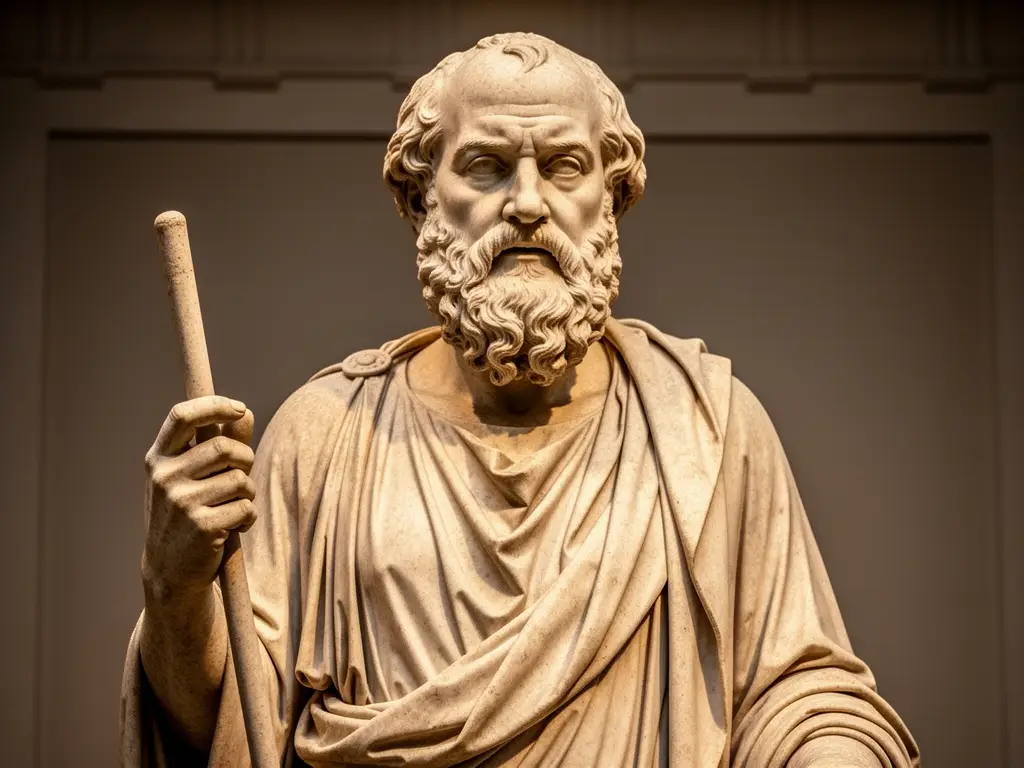
How I Came To Learn About the West
We live in a Westernized world and when you are in the middle of something, it’s really hard to see the forest for the trees. Because of this I think a lot of people don’t understand: what’s so unique about the Western tradition, what’s persisted over time, the ways in which it ends up being part of problems we don’t need.
Started zooming out from the Western tradition when I started asking the question of why, as a tradition, it’s had so much trouble understanding the philosophy of other traditions. This was something I pursued while thinking about translation. While I was doing this research I came to appreciate that what was really basic to the Western tradition and explains so much about it is the linguistic account of thought or Lat, which goes back all the way to its very beginnings.
People are often uncareful when they talk about the West geographically. It spans North and South America, Europe, and Africa. When we’re talking about Western philosophy and Western civilization, we’re really talking about a very specific tradition that goes back to the ancient Greeks. That’s why I use the capital W, leaning on the est, to distinguish a geographic location.
Understanding Western Philosophy
Understanding Western philosophy is really about understanding the unquestioned importance and assumption of the conflation of thought with language: LAT. When you conflate thought with what you say in your language, you conflate what you can think about with what your culture finds acceptable.
If this is your starting point, you grow into a tradition that understands everything in terms of humans because language is a human medium, but also in terms of community because linguistic differences demarcate communities. As a result Western moral philosophers have, since Plato and Aristotle, conflated ethical questions with questions of what it is to get along in our human community. What this leaves outside of the question that moral philosophy should really be dealing with is: how to deal with and interact with people who don’t share our language and culture, what do we owe to nonhuman persons, such as other animals and the Earth.
These are questions you can’t really articulate in the Western tradition. It grows into a tradition that treats everything outside of it as basically nonexistent. If it is to be recognized, it has to be recognized in terms of its subordination to the culture and history of the West.
With respect to questions about knowledge, LAT conflates the knowable with the kinds of acceptable things we can say in language. With respect to reality, questions of metaphysics, LAT ends up problematizing ideas of objectivity and truth independent of language. Hence, tradition ends up problematizing objective reality and normalizing the culturally relative.
Western Creation of Religion and the Normalization of Colonialism
In my research, what I discovered was that colonial traditions based on LAT end up taking ideas that colonizers find attractive or desirable from the indigenous people they are colonizing and then presenting them as their own. Correlatively, in the process of colonization, which involves imposing the colonizer’s language and culture on the indigenous colonized, indigenous people end up saddled with the pathologies of the colonizing tradition
One way this is rendered invisible is by the assumption created by the Western tradition that religion isn’t itself something completely fabricated by Western colonization.
If anyone cares to look at the history of the idea of religion, they’d learn that it was invented by the Romans. The Romans used it to legitimize groups as subordinate within their colonial structure. If you were deprived of the classification of having a religion, like early Christians, you were actually persecuted. Having a religion isn’t all that much better because to have a religious identity is to have your tradition treated as though it’s not relevant to how we get along in a diverse contemporary world.
The complete sham of the idea of religion started falling apart for me as I started to learn about Hinduism. The word "Hindu" is actually Persian. It’s not Indian and was used by the British in their colonial administration of India to invent a supposed religion of South Asians in which every possible philosophical position resides.
Once the identity of Hinduism is invented, colonized South Asians mediate their understanding of their own tradition through the West. The Western tradition, no matter what, is presented as secular and the thought of Black, Indigenous, and People of Color, in contrast, is presented as religious no matter what.
If you actually paid attention, you would find that there’s no commonality among positions that are defined as religious. Any position that is said by someone in the Western tradition, no matter what, is counted as secular. The same position, when said, say, in Sanskrit 2,000 years ago, will be counted as Hindu because of its racial origin.
Most people don’t pay attention. The actual products of Western colonization, such as religion, end up being used to understand non-Western traditions as though that’s what they indigenously are. That makes it seem as though the West is uniquely non-traditional, rational, and the source of humanity’s secular wisdom.
Controled Studies: What Data Based Generalizations can Teach Us
When I start talking about this, people often get confused. A knee-jerk reaction is to claim that there’s something wrong and illicit about generalizing about the whole Western tradition, but generalizations are not necessarily wrong. Good generalizations are actually based on the data.
If we consider what scientists do when they engage in controlled studies, they start off with different populations and then introduce different starting points and variables in each population. They track the outcomes of the members of those population over time. If they observe detrimental or beneficial results only in those populations with a certain starting point in comparison to control groups, then they are able to establish something about the efficacy of that distiguishing factors.
We can do the same with human history. We can look at the three ancient civilizations with surviving traditions of philosophy:
- the Western
- the Chinese
- the Indian
In ancient India the Linguistic Account of Thought was not endorsed and universally rejected. China had a complicated starting point. Confucians affirmed it and Taoists rejected it. The West is unique in acclaiming LAT with no critical discussion. It is also unique in being the global colonizing tradition.
My various works show that LAT is not simply correlated with colonization. It explains how colonialism works but also the outcomes of colonization. The outcome of colonization is the spread of the language and culture of the colonizing tradition. That would only be something a colonizing tradition would be invested in if they thought that language was really central to how they were to understand themselves and their projects. The enironmental degredation and extinction of nonhuman species, and erasure of Indigenous peoples, are all easily explained by the antropocentrism and communitarianims of LAT.
The radical openness and secularism of ancient India are correlatively explained by its rejection of LAT because it never confused thinking with culture. Ancient South Asians were far more open-minded and critical. They were open-minded about possibilities that were not ordinary in their culture and also very critical of practices that only had their foundations in tradition and culture.
Why We Miss All of This
Most people don’t appreciate the problems with this tradition because, as it spreads as a colonizing tradition, it appropriates smart and good ideas from the traditions it colonizes. The Western tradition doesn’t appear to be particularly problematic because, as it evolves and becomes a tradition that proclaims the universal importance of human rights, equality, and science, etc., these innovations only show up after the second and full-fledged kickoff of Western colonization in the modern period.
As the West starts to interact with indigenous peoples all around the world, this colonial interaction brings back capital that it could then invest in projects including science, but also new ideas. Of course at this time Western moral philosophers move away from the traditional hierarchicalism Western moral and political philosophy as found in Plato and Aristotle: two words, ideals of universal freedom and equality. Unsurprisingly these values are really then redefined as distinguishing features of the Western tradition while the colonized people that they’re taken from are depicted as backwards, hierarchical, and unprogressive.
Why This Matters
If you want to stop a disease or problem, you have to understand its history: how it was contracted and what you could do differently to avoid those problems in the future.
Insofar as the Westernized world we live in is heading towards all sorts of catastrophes, environmental and social, if we want to avoid these, we need to invest in thinking and understanding how we got here and how we can do things differently. That involves both understanding the Western tradition and the colonized Indigenous traditions it’s tried to erase.
For more on this, see Moral Philosophy and Decolonialism.