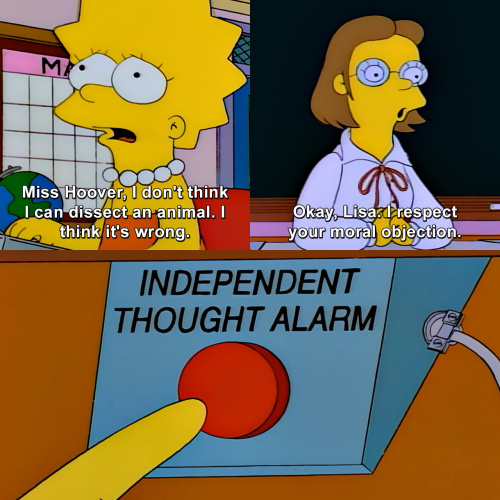
An important distinction that is rarely respected is the one between the expert and the authority.
Authority: Power to Enforce a Decision. A police officer is an authority. If they stop you, they can put you under arrest. Even if they do so on the basis of a mistake—if it turns out that you are not guilty of what they are accusing you of—they still possessed the authority to arrest you.
Expertise: Knowledge to Explain and Decide a Controversy. This is why at trial, in places that maintain respect for evidence, the expert is not the same as the prosecuting authority. The expert is a special witness called in to elucidate the controversy.
Judges in their courts and professors in their classes are both experts and authorities in their domains. However, there are limits, and their decisions can be audited.
In scholarship, an expert is not just someone who can shed light on a controversy, but also someone who pushes the literature and state of learning beyond the status quo. In every case I list below, I have produced results that both elucidate controversy and push the literature beyond its previous interpretive states. And I think I’ve been able to make contributions in so many of these areas because I’ve pursued research as an exercise of elucidating controversies. I’ve always been more interested in that than defending my view. The latter is a desire that gets in the way of being a good student of philosophy. And I think it’s rather a shame that most philosophers waste their time trying to defend a pet view. That’s a surefire way to contribute something that will be partial, one-sided, and not very interesting in the long run. It’s a way of pursuing philosophy that is barely different than interpretation.
Moral Philosophy, Ethics, has been a dominant theme of my research over the past 30 years. It’s the most practical philosophical topic I can think of but is often treated as subjective and not as amenable to objective research as we could do in the sciences. That’s demonstrably wrong.
We live in a small world. If we cannot accurately translate what other people say in other cultures and languages, we are in big trouble. The problem is that, at least when I started this research, the leading thinkers on the topic had no advice for how we could translate anything accurately.
South Asian, or Indian, philosophy is one of the three ancient traditions (the other two being the Chinese and the Western). It is the source of a lot of ideas that seem contemporary and modern, and it’s study has been botched, at every turn, by interpretation.
When I was a junior scholar, I was often told that you cannot possibly be an expert on a whole tradition. And that depends in part on being unclear about what expertise is.
Metaphysics, or the philosophy of reality, was never anything I had much interest in diving into. I was more interested in the question of how we can conduct research well. But at some point, you realize it’s the thing that research is about, and then… I was saying something about new about reality.
Knowledge? What’s that? A lot of my work was about figuring that out, but at very abstract levels that would illucidate when any kind of research was succesful. And, as I followed that thread to the end, I realized that my work had something unusual to say about knowledge.
Academics and professionals who offer services on the basis of the empirical sciences often like to cite peer review as a quality control measure for knowledge. However, the reality is that it’s an unregulated process that relies on the (irrational) assumption that people who succeeded by this process are apt judges of future work. And if it was never regulated, we have every reason to believe it’s corrupt.