
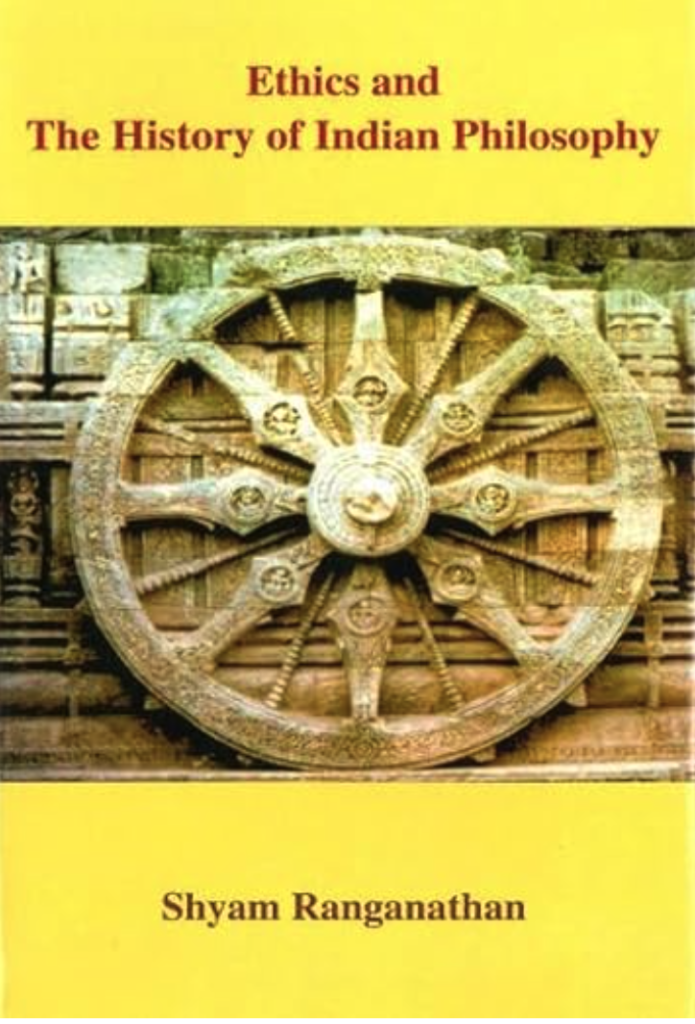
This is my first book. It has many flaws, but it also has many strength as it was the first to identify what the problem in the literature is, when speaking about the so called absence of ethics in the South Asian tradition, and what a possible solution would look like. It was based on my South Asian Studies MA Thesis. Written in the late 1990s, early 2000’s. Published in 2007, the year I defended my dissertation.
The most popular symptom of this concern is the doctrine of karma, according to which the consequences of actions have an evaluative valence. Ethics and the History of Indian Philosophy argues that the orthodox view in Indology concerning Indian ethics is false. The first half the book deals with theoretical issues in studying ethics: defining moral terms, understanding the subject matter of ethics so as to transcend culturally specific substantive commitments and touches upon issues of cross-cultural hermeneutics and translation. The second half consists of a systematic explication of the moral philosophical aspects of nine major Indian philosophical schools. I argue that “dharma” in its various uses in Indian philosophy is always rationally treated as a moral term—even in so called “ontological” employments of the term as seen in Buddhism and Jainism. In understanding “dharma” in this manner, the Indian philosophical tradition is replete with different versions of moral realism that fit tidily with other philosophical commitments of Indian philosophers. Pains are taken to show the breath of moral philosophical disagreement in this tradition. On a comparative note, some Indian moral philosophy resembles realist approaches of the Western tradition (such as the Non-natural realism of Neo-Platonism, or the Naturalism of Utilitarianism). Out of the major Indian philosophical schools, a slim minority are shown to be committed to moral irrealism while some are shown to regard their entire philosophical orientation as firmly planted within moral philosophy (such as Jainism, Buddhism, Purva Mimamsa and Yoga). In response to those who would argue that what Indian philosophers meant by “dharma” is very different from what moral philosophers in the West have meant by “ethical” or “good,” I argue that this is as vacuous as noting that Utilitarians have a different conception of the good from Deontologists. If philosophy is concerned with theoretical debate, as I argue it is, philosophical terms function to articulate such disagreements. The various seemingly desperate uses of “dharma” in the Indian tradition are no longer confusing or disorderly when we understand the theoretico-philosophical function of this term in Indian philosophical disputes. The second edition contains an additional chapter that addresses the colonial and political context of the study of Indian Ethics.