
Shyam Ranganathan

Translating Evaluative Discourse

Translating Evaluative Discourse

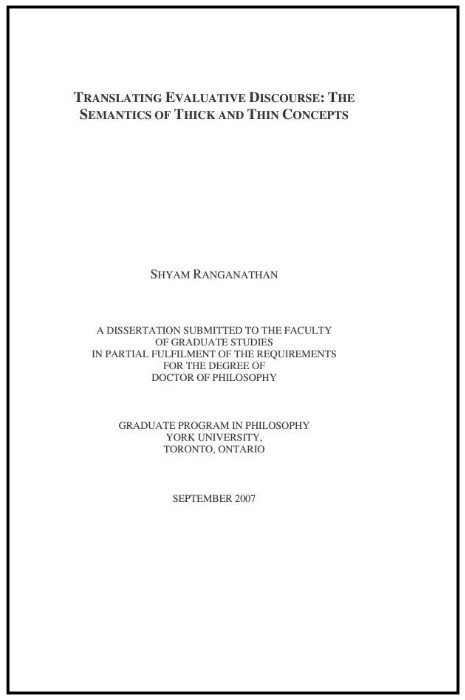
This is not a book in the commercial sense; it is my PhD dissertation, available online via my PhilPapers page. It marks the beginning of my mature research program.

In this work, I address a central problem: how translation can be accurate at all despite linguistic and cultural differences. Many influential views are skeptical about the very possibility of translation. I argue that this skepticism rests on a deeply flawed model of thought—one that mistakenly identifies what is translated with linguistic or cultural meaning, both of which are historically contingent and language-specific.

Drawing on work in Translation Studies, I argue instead that translators translate texts, not languages, and that the kind of meaning preserved in translation is genre-specific. On this account, translation is less like decoding a message and more like reconstructing a sculpture in a different medium. The genre of the original text determines what is organizationally salient, and these features constrain how a non-equivalent medium can be used to produce a text that is semantically isomorphic with the original.

Although this work is framed as a theory of translation, it is ultimately about inquiry itself—and about the possibility of understanding knowledge as something that can be separated from subjectivity, individual psychology, history, and culture.

This is not a book in the commercial sense; it is my PhD dissertation, available online via my PhilPapers page. It marks the beginning of my mature research program.

In this work, I address a central problem: how translation can be accurate at all despite linguistic and cultural differences. Many influential views are skeptical about the very possibility of translation. I argue that this skepticism rests on a deeply flawed model of thought—one that mistakenly identifies what is translated with linguistic or cultural meaning, both of which are historically contingent and language-specific.

Drawing on work in Translation Studies, I argue instead that translators translate texts, not languages, and that the kind of meaning preserved in translation is genre-specific. On this account, translation is less like decoding a message and more like reconstructing a sculpture in a different medium. The genre of the original text determines what is organizationally salient, and these features constrain how a non-equivalent medium can be used to produce a text that is semantically isomorphic with the original.

Although this work is framed as a theory of translation, it is ultimately about inquiry itself—and about the possibility of understanding knowledge as something that can be separated from subjectivity, individual psychology, history, and culture.

About the author

Dr. Shyam Ranganathan

Dr. Shyam Ranganathan is a translation theorist, philosopher, and teacher. He is the author of five books, one translation, one edited volume, and numerous scholarly papers. His work spans ethics, political philosophy, and the philosophies of thought, language, religion, race, and artificial intelligence, as well as Asian philosophy—especially Indian philosophy, Indian moral philosophy, and philosophies of meditation. His research addresses the intersection of models of thought and explanation and their practical implications for how we live. He is an expert in Western and Indian philosophy and has also written academically on the Chinese tradition.