

Books & Publications
I am the author of
five books (one of which I coauthored), two edited collections
(one online), one published translation, and numerous articles.
BOOKS
From Academic Philosophy to Public Philosophy.
I take being a philosopher seriously. Philosophy is a discipline, like mathematics, chemistry, or linguistics. While a lot of my research has been interdisciplinary, straddling history, the study of religion, languages, translation, and area studies (Indology), I think it’s vital to have a firm foundation in a discipline from which one can make contributions. And this has led my work to be paradoxically technical and something nonspecialists can read. And over time, I have written increasingly to a nonspecialist, nonphilosophical audience.I think a lot of academic philosophy has gone off the rails because it is a wild departure from the basic disciplinary criteria that we learn as students. That makes most academic philosophy both inaccessible, but also not rigorous and not serious enough. It seems serious, as it often involves a conversation about what’s going on in the literature of late. But philosophy is 3,000 years old. Plato never gets old. Neither do the Upaniṣads or the Tao Te Ching. If a work of philosophy cannot address questions at the level of its timeless importance, it speaks more to a flash in the pan than something that will endure.
I think that because I’m serious about getting back to the basics of philosophical education, my work can be read by nonspecialists. It will no doubt be a challenge, for it involves getting up to speed on what it is to understand and engage in philosophy. But that’s a learning curve that people have the capacity to engage in. It’s hard for nonspecialists, in contrast, to dive into something rarified and part of a discussion of recent literature if they are not already familiar with it.
I am an innovative philosopher (I say this with ironic irony) because I think we should study any proposal as an introductory philosophy student is encouraged to do. That is to look for the reasons that support a conclusion, and we know we’ve found the reasons when we can deduce the conclusions. This requires not using your beliefs or sense of what is true as a criterion of what you are trying to understand. I call this explication. What this allows is an appreciation of history, where peoples from previous times had different kinds of reasons for different kinds of conclusions. And we can also see how they were engaging in explication, as they were able to explicate each other’s proposals. And so using explication, we can track changes in the kinds of projects people were trying to get behind. But what this also reveals are sudden, hard shifts from an explicatory approach to an interpretive approach to explanation. When people start to interpret, they get behind a shared outlook, and then instead of explaining in terms of reasons for conclusions, they impose a perspective that everyone has to conform to, resist, or perish under. So with this rise in violence, reasoning disappears. And there are hard moments in history when these shifts happen, and as you can track the change from explicatory approaches to life to interpretive approaches to life, you can correlate this with the movement and changes of traditions. And corruption is held together by this normalization of oppression.
Why Comparatively Studying South Asia and the Western Tradition is Interesting
The original idea behind secularism is that the secular is an exercise of free thinking (REF). Secular environments are hence environments where people are allowed to pursue arguments and ideas as they please. There is no dogma that is imposed on everyone or bought by everyone. All ideas are up for debate, and every possible idea and theory is defended and discussed.
Draw up a list. Secularsim2. Interpetation on the basis of the West. Because if we explicate, we find that Hinduism, Secularism1.
My work on South Asian philosophy (all of it, actually) was an opportunity for me to work out how we could learn philosophy at all and how history and oppression get in the way. My book on Hinduism, for instance, seems to be on a religion. But it’s actually about how British colonialism redefined a free and open tradition of philosophical thinking—where there was no common viewpoint but a debate on every topic in philosophy—into a religion (a story about some common viewpoint that South Asians share) so it could succeed at its colonial ends, which were to present itself as the solution to the backward ways of South Asians.
By this standard, the Western tradition was not secular. If you head back to its earliest times, it is characterized by a history of persecuting free thinkers and philosophers (Socrates, Jesus, Boethius, Hypatia…). Moreover, it was the Romans who invented the idea of religion, which was a way to normalize a colonized tradition within its fold. Not every tradition was given this recognition. Early Christians were persecuted. It would have been dangerous for the Romans to acknowledge Christianity as a subordinate option within Rome because Rome had killed and tortured Jesus, their leader, to death. So certain alterations to doctrine had to be made in order for Christianity to be defined in such a way that it got Rome off the hook. And we can see these innovations in Romans, by Paul.
Story about Seculars west is about normalizing oppression.
Learning about what pre-colonized South Asians were up to is a way for us to imagine and learn what a free life for us could be like. Some of it will appear familiar. Part of it consists of multiculturalism and openness to diversity.
Today, Western people who identify as Liberal think they made up the idea that we should value diversity. However, if you know the history of Western moral philosophy, starting with Plato and Aristotle, you will know that these are not Western ideals.
I’m not the first to point out that Western colonizers, when they came to colonize Indigenous peoples, were often deeply committed to hierarchy and inequality. David Graeber and David Wengrow in their famous The Dawn of Everything point out how the French colonizers in modern-day Canada were shocked at the egalitarianism and relative freedom of the Indigenous peoples they ran into (the Wendat). And then, magically, at about the same time, French and European philosophers started talking about freedom and egalitarianism as though they made those ideas up.
In my work, I add to this by showing that many of the ideals associated with Liberalism via John Stuart Mill’s famous writings (which you can find in his On Liberty) were actually South Asian. South Asia was a land of multiculturalism, intellectual diversity, and intellectual freedom. This contrasts with the West. At the start the West, Socrates gets put to death by the Athenian court for promoting false gods and corrupting the youth. In ancient South Asia, the debate was about, what values (gods) to revere and how to raise responsible adults. There was no history of killing public intellectuals in South Asia as there was in Europe. Moreover, a central feature of this South Asian space was the idea that we should be free to experiment in life and choose our own values. This is actually an essential doctrine of the ancient philosophy of Yoga. Mill in On Liberty makes an impassioned plea that we should set up society to allow people to experiment and decide their own priorities, as long as they allow others to do the same. But, in the same breath, he claims that this freedom is only for racially mature people unlike South Asians, who would be so lucky as to be governed by a despot.
Mill’s day job was working for the British East India Company; he was a professional colonizer.
My work shows that colonialism has this strange way of imposing the pathologies of the colonizers, who then take what they saw among freer, Indigenous people (often a value in freedom and egalitarianism) as though they made up that idea themselves, while the people they colonized are stuck in some backward stage of development that is the colonizer’s past. In my recent book, Moral Philosophy and De-Colonialism, I call this the colonial exchange. And whereas Graeber and Wengrow raise the question of how it is that we get stuck in political ruts, my work answers this question by pointing out that the same mechanism that gives rise to oppression (interpretation) is appropriative (it would explain how Europeans took the intellectual labor of Indigenous people they were colonizing as their own) but it also leads to an intransigence. (I’m grateful that Wengrow wrote the endorsement for this book.)
If you identify with the colonizer, my work will be aggravating. But if you acknowledge and recognize the ways in which your own freedom has been limited by imposed expectations, you may come to appreciate the ways in which others have taken advantage of you and left you with their baggage. Same phenomenon. That is the colonial exchange in your life.
Toggle Content
Being a student of philosophy and sticking to the basics of learning philosophy reveals many surprising results. The first surprising result that I discovered was that while Western philosophy is usually just depicted as philosophy (while everything else is religious), it creates these narratives by defining its culture as the content of thought because of its acceptance of LAT. And then, oddly, if we really want to get away from thinking about philosophy in terms of the culture and ethnicity of the West, we have to do a lot of abstract work on the nature of thought, reason, explanation, and method in philosophy to overcome the ways in which, in standard discussions, the peculiarity of the Western tradition is conflated with what we can think about. And so my work in philosophy has been a kind of zig-zag. At some times it would be focused on the Western tradition, and here I would be identifying its problems and coming up with solutions. (This was what my PhD dissertation was like.) And then, when I would switch to South Asian philosophy, I would try to learn it by the methods of basic philosophy education, and what I would find are resources for thinking about philosophy that helped overcome a lot of the ethnocentrism of the West.
Most people don’t do this because they treat the things that the West creates, like religious identity, as a fact about non-Western traditions. And then they try to understand these traditions as examples of religion and spirituality. And while certainly that’s the way people who have been colonized often think about their tradition, that has to do with colonization and not what is indigenous to those traditions.
And so going back and forth between the Western tradition and non-Western traditions, especially South Asia, has played a huge part in my thinking about philosophy as a discipline, like math or science, that has definite core topics and can definitively solve its own problems. I think ultimately the reason that Western philosophers tend to be skeptical about philosophy’s objectivity and its capacity to answer its own questions is because they have confused LAT and the ethnocentrism of Western philosophy with philosophy.
Getting rid of prejudices and biases is liberating for us.
I find lots of people are impatient with thinking about the origins of our prejudices and perspectives. They want quick fixes. How is understanding the past going to help us move on? The reason we need to understand the past is that if we do not understand it as the past, we do not allow ourselves to move on. What happens instead is that the programming of oppression runs deep. And I find looking at the history of the rollout of this programming is helpful to see the ways in which it continues to operate in our own lives, from which we can choose to depart.
One of my criticisms about most of the writing on non-Western philosophy by academics is that it doesn’t actually teach us anything. It just imposes the prejudices and assumptions that are created by a history of oppression onto narratives about colonized peoples. As I show in my work, some of these are so old (like the idea of Secularism2, where everything Western is secular, no matter what the content, and everything non-Western, no matter what, is religious) it’s hard to get our heads out of the propaganda.
What is unique about my work is that I think about occasions to study philosophy from people long gone and languages that no one really speaks anymore (like Sanskrit), as opportunities to get back to the basics of learning philosophy. If we consistently apply those really basic, introduction-to-philosophy critical thinking skills to the challenge of learning from these long-gone traditions, we can learn from people who may have had ideas that we weren’t allowed to contemplate, given the history of oppression.
Focusing on the basics of philosophy provides occasion to liberate ourselves from biases and assumptions that limit our own agency. We’re better off without them, as they limit our thinking and our appreciation of options. And they constitute dead weight we carry around in our soul, without knowing it.
Grief, Loss, and Continual Rebirth and Renewal
My contribution to the coauthored book, Life After Death, argues that the question of whether we have a life after death is moot. We are always living after the death of some time or portion of life.
Life and death are continually occurring events. But is it for us to continue to live? My point is that our capacity to survive grief, loss, and injury depends on our opportunity to cultivate our own agency. And that takes the kind of Phitness work that I have spoken about on the main (About) page and in My Story.
This is one of those topics where scholarship meets real life. Life is filled with bad things. And each bad thing is a backdrop against which we can plot a comeback, if we can seize what opportunity we have to work on our agency. Oppression is real. It gets in the way. But all the more reason for us to work on our own agency, so that we act as allies to ourselves, and not agents of our own suppression. Each one of us has an interest in being liberated from the history of oppression. And the way to do that is to work our Phitness.



Chronology of my major projects
MA in South Asian Studies (1996–2002)
During this period, I first addressed the widespread myth that South Asian philosophers are uninterested in ethics. I argued instead that
every use of the term “dharma” is an ethical employment. Because the concept is ubiquitous across South Asian philosophical traditions, so too is moral philosophy itself. This work culminated in my first book:
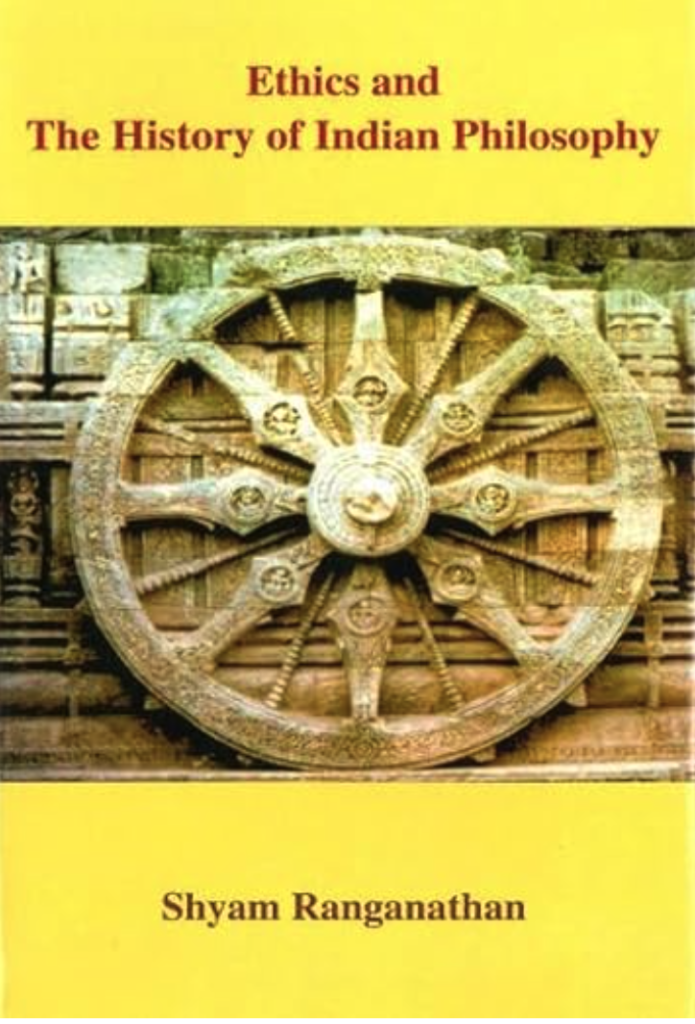
2007 — Ethics and the History of Indian Philosophy (Motilal Banarsidass)
A systematic demonstration that ethical theory is central to Indian philosophy, directly challenging its exclusion from mainstream moral philosophy. While this was an attempt to provide a non-interpretive account of Indian ethical theory, it wasn’t successful as it relied on LAT to make sense of the topic. But, one insight that I kept was that a term like "dharma" functions in Indian philosophy to articulate moral theory.
PhD in Philosophy (2002–2007)
While I regarded my earlier work as broadly correct, I came to see that it lacked sufficient rigor. I therefore shifted my focus to
translation as such, and to the translation of moral philosophy in particular. This research was grounded primarily in Analytic philosophy, while also engaging Continental philosophy and Translation Studies. During this time, I also undertook a translation of Patañjali’s Yoga Sūtra, resulting in two major works produced in parallel:
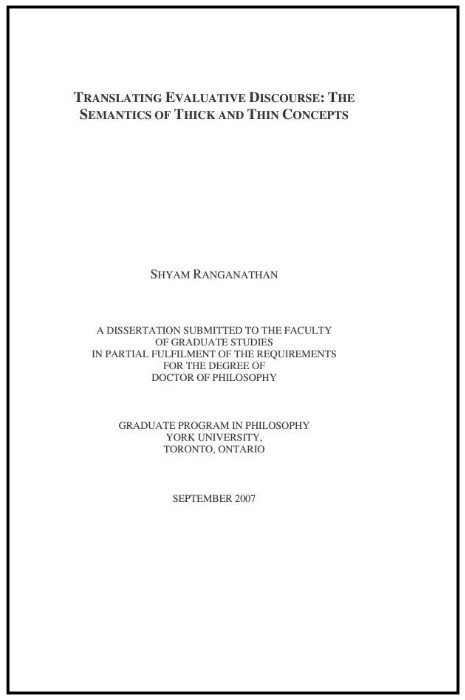
2007 — Translating Evaluative Discourse: The Semantics of Thick and Thin Concepts (PhD dissertation, York University)
Famous philosophers in the Western tradition have written on translation, and they almost all complain about it as something imprecise or problematic. The idea that something can be lost in translation represents this approach. It was during this research in Analytic and Continental philosophies of language, as well as the interdiscipline of Translation Studies, that I came to appreciate that everyone in the Western tradition, going back to the ancient Greeks who operated with the term logos (a word for language and what we can reason about, which are thoughts), operated with the Linguistic Account of thought. Translation in this tradition is framed as matching up words and sentences across languages, and the problem is that because languages are different, this seems impossible. I proposed a different way of thinking about translation. Following some important ideas in Translation Studies, I argued that we don’t translate languages; we translate texts. Moreover, we have to choose to treat a text as an example of a genre (a text-type) and that provides criteria for salience that can be isomorphically reconstructed in a translation with different media. This operates with a different model of thought I call Linguistic Externalism.
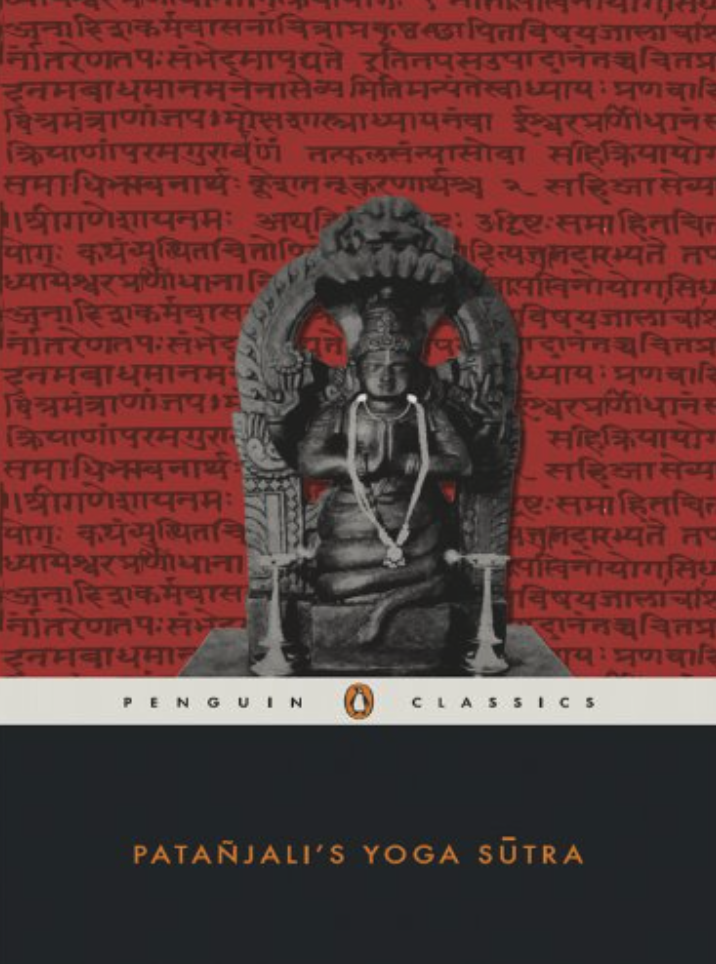
2008 — Patañjali’s Yoga Sūtra (Penguin). A philosophical translation with an extended introduction situating the text historically and arguing for its status as a rigorous contribution to philosophy.
Post-PhD / Junior Scholar Phase (2007–2018)
This was a difficult period professionally. I was on the market for an academic job. Philosophy departments seeking specialists in analytic ethics or philosophy of language were uninterested in my work, which fell outside traditional Eurocentric boundaries. At the same time, positions in South Asian philosophy that I could also apply for were adjudicated by people who believed the usual myths that South Asian philosophy lacks a rigorous history of ethical thinking. And so I was rather unpalatable there. I was lucky to secure a fixed-term professorship at York University, and even before and afterwards, I was contract faculty there.
It was during this period that I developed the interpretation / explication distinction, which fundamentally transformed my understanding of inquiry and research.
Two major projects emerged from this insight:
2017 — The Bloomsbury Research Handbook of Indian Ethics (ed., Bloomsbury Academic)
A reference volume organized around core topics in moral philosophy, aimed at correcting the marginalization of Indian ethical thought and demonstrating its relevance to mainstream ethics. At the time of publication, only one comparable volume existed; this work remains unsurpassed. I edited the volume, wrote the introduction and contributed two chapters to the collection. It was the first volume on Indian ethics that was premised around explication.
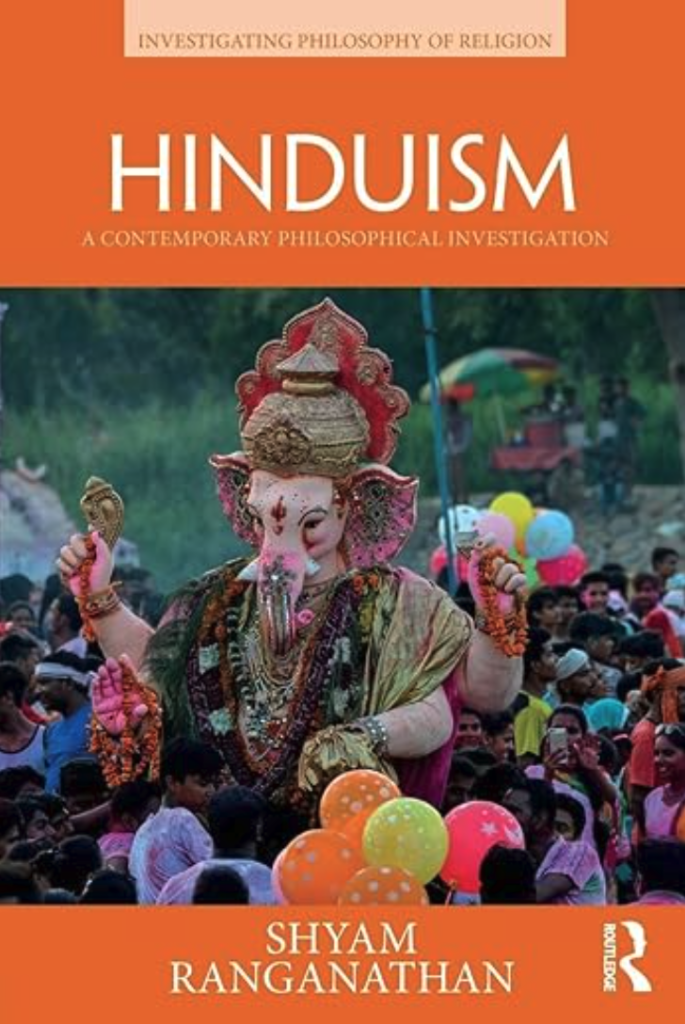
2018 — Hinduism: A Contemporary Philosophical Investigation (Routledge)
A philosophical examination of “Hinduism” and the secular/religious distinction. It begins with the historical observation that it was the British who used "Hinduism" to identify the Indigenous religion of India. But what it actually named was entire, internally diverse history of South Asian philosophy—encompassing ethics, logic, epistemology, metaphysics, and political philosophy. And when we explicate this history, we see that there was no central doctrine that defined Hinduism as it was a debate. It is rather Secular1. After colonization how Hindus understand their tradition changes, as they interpret it according to the West.
Across this period, a central conclusion became increasingly clear: the West invents the category of religion by interpreting BIPOC traditions, thereby erasing their moral philosophy. I also start introducing the idea of LAT and LE as essential parts of these equations.
Senior Scholar Phase (2019–Present)
Although I first articulated the interpretation/explication distinction in a Westernized academic context, I came to recognize it as a restatement of fundamental distinctions already present in the Yoga tradition. This realization led me to explore the political implications of Yoga philosophy, and the ways this tradition provides resources for critiquing oppression.
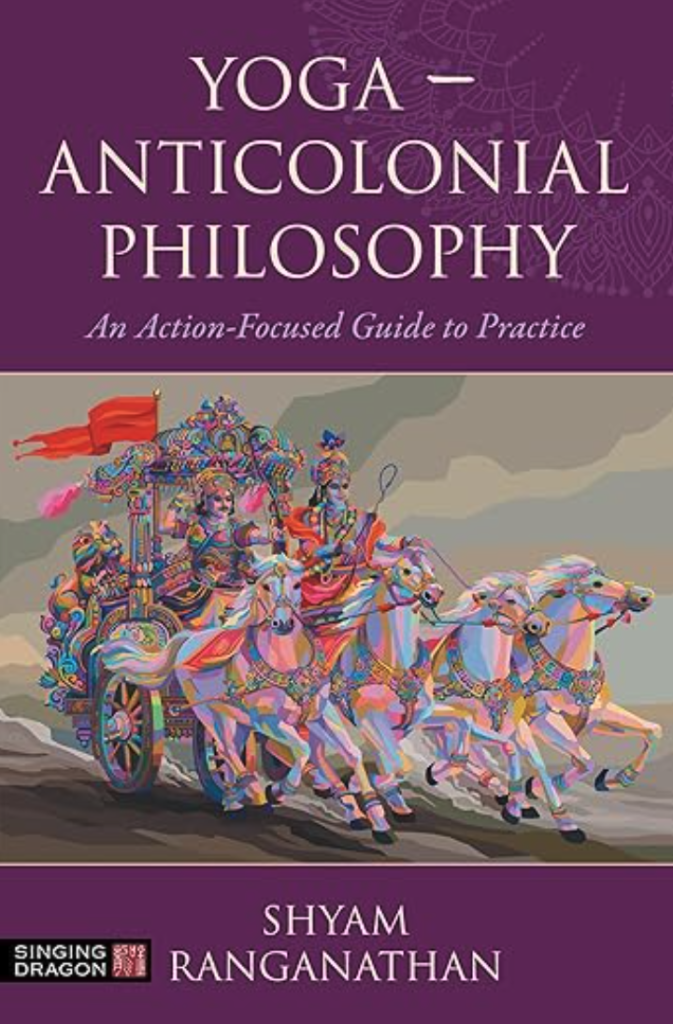
2024 — Yoga–Anticolonial Philosophy: An Action-Focused Guide to Practice (Singing Dragon).
A decolonial, practice-oriented work presenting Yoga philosophy as action-guiding and historically intelligible prior to colonial reframing, while remaining philosophically explicit. This is the only introduction to an Indian school of thought, I know of, that is grounded squarely in moral philosophy. One of my achievements, aside from clearly formulating explication, was to show that explicated, the South Asian tradition contains a fourth basic ethical theory (aside from Virtue Ethics, Consequentialism and Deontology) and that theory is Yoga. Accordingly, the right thing to do is to be devoted to Sovereignty, by practicing its essential traits (unconservatism and self-governance) and the outcome is our autonomy. As an ethical theory, Yoga is explicitly anti-colonial, as colonialism is devoted to erasing our autonomy and Yoga, the ancient practice, resists that.
2026 — Moral Philosophy and De-Colonialism: The Irrationality of Oppression (Bloomsbury Academic).
This book applies the interpretation-explication distinction to understanding human history, and where it has brought us. Colonization depends on LAT, which is an interpretive model of thought. Indigenous life depends upon LE. Colonization requires that we share a set of values and a perspective in order to get along. A de-colonial, Indigenous space is based on the value of the public practice of moral philosophy by way of explication. In an unoppressive, Indigenous world, we each get to think clearly, choose freely, and live in accordance with our choices. Put another way, the rational purpose of life is for each of us to engage in moral philosophy and to figure out what is important to us. The major philosophical accomplishment here is the demonstration that oppression is not a result of improper values. It’s a function of irrationality, and so we have a rational obligation to oppose oppression and to de-colonize. Colonization survives because it is appropriative. We all have an interest in arresting oppression. This also shows that oppression confuses a life of free, personal freedom, for it conceives of that freedom in terms of oppression: it seems we cannot all freely live our lives, for each one of us doing so would be impeding the liberty of others. That’s an illusion that confuses choosing our values and living accordingly with interpretation.
2026 — Life After Death: Four Views (Bloomsbury Academic; multi-author volume)
A four-position dialogue. My contribution, “The Reincarnation View,” argues that life and death are continually occurring events and that we are best understood as abstract moral agents defined by our obligations. While mind, body, and experience change, moral agency itself does not perish.
Full Bibliography from PhilPapers
One moment, publications loading ... (or view them here)